
Dining Tables
Shop Melbourne's best dining tables — marble, travertine, oak, extendable and ceramic. Buy online or visit one of our 5 Melbourne showrooms.
35 products


Frequently Asked Questions
How to Choose a Dining Table
A dining table is bought once a decade, sits at the centre of the busiest room in the house and has to work for weeknight dinners, homework, laptops and the occasional twelve people at Christmas. That is a lot to ask of one purchase, which is why the order of decisions matters: size and shape first, because the room dictates them; then top material, because that determines how the table lives with your household; then base and legroom, which decide how many people can actually sit at it. Style comes last and looks after itself once the first three are right. Our range spans marble, travertine, ceramic, sintered stone, oak and solid timber in round, oval and rectangular formats, with fixed and extendable options, and every one of them can be seen and measured against real chairs across our five Melbourne showrooms.
Sizing the Table to the Room, Not the Seats
Start with the room rather than the number of people you want to seat, because clearance is what makes a dining room usable. Allow 90cm to 100cm between the edge of the table and the nearest wall or furniture so a chair can be pushed back and someone can still walk behind it. In a tight room, 75cm is the absolute minimum and it will feel snug. Subtract that clearance from your room dimensions on both axes and whatever is left is the largest table the space can carry. Then check the seating: allow around 60cm of table edge per person, so a 1.8m rectangular table seats six comfortably, 2.1m to 2.2m seats eight, and 2.7m gets you to ten. A 1.2m round table suits four to six, and 1.5m round handles six to eight. Mark the footprint on the floor with masking tape and leave it for a day — walking around a taped outline reveals a table that is 20cm too long far more reliably than any measurement on paper. For a full breakdown of dimensions by seat count,read our dining table size guidebefore you settle on a size.
Round, Oval or Rectangular
Shape is decided by the geometry of the room and how you use the table. Rectangular tables seat the most people per square metre and suit long rooms and open-plan spaces where the table runs parallel to a kitchen bench. Round tables work better in square rooms and in tight corners of open-plan areas — there are no corners to walk around, and conversation flows more easily up to about six seats because everyone can see everyone. The trade-off is that a round table stops being sociable above roughly 1.5m, where the middle becomes too far to reach across. Oval tables are the compromise worth considering in a long room that feels crowded by a rectangle: they seat close to rectangular numbers while the softened ends free up circulation at each end. If the table will sit against a wall much of the time, or double as a homework and work-from-home surface, a rectangle is the more practical shape. Leaning towards a circular format?see round dining tablesfor the diameters we carry.
Choosing a Top Material You Can Live With
Material is the decision that determines daily maintenance, so be honest about the household. Ceramic and sintered stone are the most forgiving surfaces we sell — heat, stain and scratch resistant, and genuinely fine for young families where a hot dish or a dropped fork is inevitable. Genuine marble is the most beautiful and the least forgiving: it is porous, needs sealing, and red wine, lemon or vinegar will etch it if left. Travertine sits nearby in character with warmer tones and a more organic surface, and also wants sealing. Solid timber and oak occupy the middle ground: they mark over time, but they can be re-oiled or sanded back years later, which no stone top can offer, and many people prefer that a timber table records the life of the household. Glass is easy to clean and visually light in a small room but shows every fingerprint. Our team will tell you plainly which tops we would not recommend for a house with a toddler. If you have your heart set on stone,compare marble dining tablesand ask us about sealing before you buy.
Bases, Legroom and How Many Chairs Really Fit
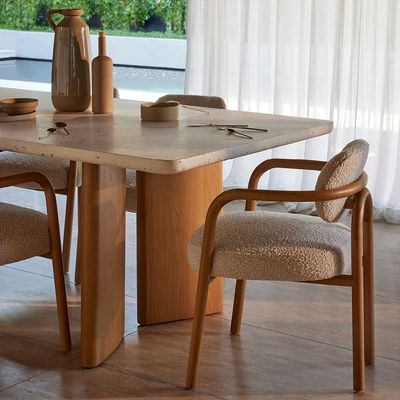
The base is where dining tables quietly fail. A four-leg table with legs at the corners fixes where chairs can sit and often means the advertised seat count does not survive contact with real chairs, especially if the chairs have arms. A pedestal or single-column base lets chairs be placed anywhere around the perimeter, which is why a pedestal round table so often seats one more person than expected. Trestle and A-frame bases look substantial but push the outer legs inward, so check that a chair at each end is not straddling timber. Two dimensions are worth measuring on any table you are considering: apron height, meaning the clearance from the floor to the underside of the tabletop frame, which needs to exceed the height of your chair arms — around 65cm to 70cm is typical — and the clear span between legs. Bring the dimensions of your existing chairs if you are keeping them and we will check the table accepts them before you order. Buying chairs at the same time?browse dining chairsand we will pair them by height and clearance.
Extending, Entertaining and Buying for the Future
Most households need two tables: the everyday one and the one that seats the extended family a few times a year. An extendable dining table resolves that without permanently surrendering the floor space — a butterfly or self-storing leaf keeps the insert with the table so it cannot be lost in a garage, while separate leaves require somewhere to store them. Check the extension mechanism yourself in the showroom, because a leaf that takes two people and five minutes to fit will not get used. Where extension is not an option, a slightly longer fixed table plus a pair of stackable or bench-style extra seats often works better than a mechanism you will not operate. Also think ahead to delivery day: measure the doorways, hallway turns and stairwells the top has to pass through, since a 2.7m stone top does not flex. Our delivery team asks these questions before dispatch, and it is worth having the answers early. If you entertain a few times a year,view extendable dining tablesand try the mechanism in person.
See the Full Dining Table Range in Melbourne
Scale, edge profile and the weight of a stone or timber top are all judged standing beside a table, so all five showrooms — Alphington, Preston, Essendon DFO, Springvale and Nunawading — keep a rotating selection of shapes and materials on the floor seven days a week, with chairs available to sit at them. In-stock tables dispatch within 48 hours, white-glove Melbourne metro delivery includes placement in the room, and Australia-wide freight covers the rest of the country. Every table carries a 10-year structural warranty, and Zip Pay is available in store and online.